
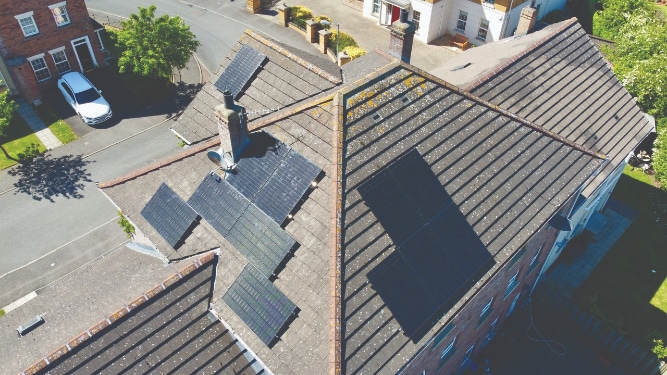
How this Co Antrim home retrofitted solar PV panels with battery and EV charger in such a cost effective way that it’s to pay for itself within five years.
In this article we cover:
- Cost of the installation and payback details
- House set up and decision to bring battery indoors
- Shopping around for the best system, price comparisons
- How the system was installed
- Battery benefits
- Typical energy consumption profiles
- How the paperwork was handled
- System size, timeline and suppliers
- Photographs of the system set up
Retirement pushed Roger Gillespie to rethink his Co Antrim home’s energy future. His solar retrofit, set to pay back in roughly five years, now keeps costs down and gives him genuine energy confidence.
After retiring in December 2024, Roger finally turned his long-held idea of installing solar panels into something actionable. He and his wife live in a 17-year-old, three-storey townhouse facing southeast – an orientation he once thought unsuitable for solar.
But as they committed to staying put long term and began thinking about futureproofing their home, he decided it was time to reassess what solar could offer. The rising unpredictability of electricity charges only solidified the decision.


Solar switch
“I’d been considering solar for quite some time,” he says. “In March 2025, I started looking at it more seriously as an investment. The banks weren’t offering much interest on our savings, so it made sense to explore other options.”
He began by researching and contacting several companies to see if solar was even viable on their property. Some dismissed it because of the scaffolding required, but he wasn’t put off.
A big motivation, he says, was their transition to an electric vehicle (EV). “We’d had a plug-in car before, and that really got me interested in the electric side of things.”
At that stage, their monthly electricity bill was about £180 on a payment plan, and he wanted to bring it down.
With a long career in sales, he’s used to working with figures, so he dug deep into the research, comparing systems and offers. “A couple of installers told me it wasn’t feasible, and two others made the usual ‘special offer’ pitches, which I ignored.”

Through a community group, he eventually found an installer who took a more collaborative approach. By then Roger already knew he wanted a larger battery, specifically a 10kWh unit, despite its hefty 100-kilogram weight.
The final system includes 12 panels, split between the rear and side roofs in a five to seven configuration. “Andrew, the installer, planned for the optimal capacity our grid allows in NI where the inverter is limited to 3.68 kW, but the array’s potential is about 5.28 kW.”
Because NI grid rules cap the inverter at 3.68kW, Roger’s system can occasionally produce more power than the inverter can process. On bright summer days, that extra generation is simply ‘clipped’, meaning the inverter limits the output to its maximum capacity.
This isn’t a flaw; mild clipping is normal in well-designed systems and actually allows the panels to perform better in low-light conditions throughout the year.


Battery benefits
Pairing the array with a larger 10.24kWh battery was Roger’s way of making the most of his setup. The bigger battery lets him store more of the energy produced during the day, reduce reliance on the grid and take full advantage of off-peak night rates to keep running costs low – especially important with an EV in the mix. It also futureproofs the home, giving him more control over his energy use in retirement.
Performance was a key priority, especially with the EV and their new energy tariff. “I take advantage of lower nighttime rates to top up the battery, so we barely use any daytime electricity from the grid. Even on cloudy days, the house runs off the battery almost exclusively.”
He is tracking all the numbers for a full-year review, but even after seven months the savings are clear. While no solar PV company can give a precise projection, his own research suggests a payback period of around five years. He also ensured all warranties were firmly in place: 10 years for both inverter and battery, and a 30 year performance guarantee for the panels.
The installation itself was straightforward. The townhouse already had a modern distribution board, and the two-person team worked efficiently – one on electrical work, one on roofing. “They even cleaned up meticulously afterwards,” says Roger.


The battery is attached to the wall in a third-floor storage area that was easy enough to access. “Because the house is three storey, we have a window f ire escape and the battery was lifted through it with a cherry picker,” explains Roger. “They were going to try to bring it up the stairs but this was much more manageable seeing how the battery weighs 100kg.”
Many people place their battery in a garage or on the ground floor, but with Roger’s house layout, and a full garage, the storage room made more sense.
And he wasn’t concerned about the battery being indoors. “There’s often debate about whether to have lithium batteries indoors or outdoors. Personally, I prefer them inside because batteries don’t like the cold weather.”
“I see people insulating and waterproofing outdoor batteries, but it’s not my preference. I’m driving around in a full EV with a 64-kilowatt lithium battery under me, so I don’t worry too much, but I understand why some do.”
They did consider placing the battery in the garage, but it would have taken up space and complicated wiring from the panels to the inverter. Instead, the installation team delivered a neat, well-shielded setup.
Everyday savings
Since the system went live in May 2025, he has used off-peak settings to keep bills extremely low. “From June to August, our net cost was only £7.46 per month – even with charging the car. Winter is a bit higher; last month it was £72, mostly because of the EV. Without the car, it would have been around £7 or £8.”

Grid registration and export paperwork were handled by Andrew. “Some installers leave you to do this yourself, but not ours,” says Roger. He has since upgraded to a smart EV charger, allowing excess solar energy to flow directly into the car. “The flexibility with solar and the smart charger has been excellent.”
So far, the savings have met or exceeded his expectations, especially between May and September. Payback varies by location, but based on his research and real world results, he expects theirs to be fully paid off within five to five and a half years.
He also switched electricity providers. “When we first installed the solar PV system, PowerNI was the only provider paying for exported energy, and the rate wasn’t great.”
“But in June, new competition entered the market, and I switched to a new provider. They buy exported electricity at the same rate as they charge for electricity during off-peak (night) hours – specifically, at a rate of 13.9 pence per kilowatt-hour, which is about 30 per cent higher than the local competitor.”
“This means that for any electricity you export back to the grid, the company credits you at this same night-rate price. As a result, if you are topping up your battery or using energy during off-peak times, the cost is balanced out by the amount you export at the same price, making your household energy use close to net-zero in cost when balanced well.”
Choosing a long-established, stable solar PV company was important to Roger. “I dealt directly with Andrew, the owner – not transient salespeople.” Comparable systems were being quoted around £8,500, though prices have continued to fall as the technology improves.
Maintenance is minimal. “The panels are self-cleaning; rainfall takes care of them. The only critical thing is warranty validity – any changes need to go through the original installer.”
The team provided clear instructions on how to monitor the system, and showed Roger how the inverter is optimising power generation and consumption. “I’m into the technical side of things so was interested to see how it all works, and make tweaks if needs be,” he says.
Roger says the aim is to keep the battery topped up at the night electricity rate, both in summer and winter, although when he’s at peak production during the summer months there are times when there’s more produced than the battery can take. In that case the inverter diverts the electricity to the car, then to the grid.
“During the summer months, if the battery isn’t full by evening time, it’s charged with a very small amount of electricity – just one amp. Switching to higher ampage (50amp) is particularly useful in winter because it keeps the battery full at the cheaper rate without overloading it or causing unnecessary wear,” adds Roger.
“When the battery is topped up, it won’t try to draw down and discharge as quickly, which helps manage energy use efficiently when sunlight is less available.”
“This training gave us more control, so we can optimise our energy use and keep the system running smoothly through the winter. Overall, I found the process much easier than expected,” continues Roger.
With careful planning and a knowledgeable team, disruption was minimal. “For anyone considering a retrofit like this, it’s important to know just how manageable the installation can be. Now we’re not only reducing costs, but we’re futureproofing our home and supporting the move toward renewables.”
I take advantage of lower night time rates to top up the battery, so we barely use any daytime electricity from the grid. Even on cloudy days, the house runs off the battery almost exclusively.