In this article we cover:
- How much they paid for the site
- Costed elements of the build
- House valuation vs build costs
- Hunting down the perfect site to build on
- Next steps after finding the site
- Open plan kitchen design
- Lighting design
- Bathroom design
- Insulation and airtightness approach
- Glazing details
- What DIY they took on
- Working through Covid
- Top tips to manage the build yourself
- Surprises, splurges and changes they would make
- Timeline, floor plans and specifications
- Suppliers and professional photographs
Overview
House size: 235sqm
Bedrooms: 4
Plot size: 1 acre
Site cost: £240k for both sites
Total build cost (rounded): £380k
House value: £1.2m
SAP (EPC): 85 (B)
Heating system: Air to water heat pump
Ventilation: Centralised mechanical with heat recovery
Build method: Block
Cost Breakdown
Architectural fees covering concept designs, material changes to planning and building control submissions: £3,750
Building control fees: £450
Water connection: £834
Electricity connection: £1,691
Warranty: £1,741
Construction (builder’s cost): £141k bare shell with roof and groundworks
Plastering: £10,000
Kitchen including appliances: £28,000
Bathrooms: £11,500
Utility: £5,370
Staircase: £7,000
Flooring: £24,000
Full electrical installation including smart home:£15,000 (self-installed)
Internal doors and ironmongery: £14,700
Windows and external doors: aluminium £11,750, uPVC £3,550, front door £2,200, total £17,500
Roof: £19,000 limestone and polypropylene slates used instead of natural slate to reduce costs
ASHP & MVHR: £20,325
Electric gates: £5,400 including gates, motors and installation
Driveway: Groundworks, kerbs £2,500 and tarmac £8,700
Builder’s merchant (paint, materials, airtight tape and membrane, ground works, estate railings, etc): £34,564


Richard is a pilot who had always wanted to design and build his own home, and after living in NI for 20 years and spending six years working for a major airline, he and his wife Marie, who works as a flight attendant, finally had the financial opportunity to make that dream a reality.
Despite such a good start, Covid took a hit on both costs and salary, and the build impacted on Richard’s health, but there was a silver lining. “One of the best surprises was how much the house is worth now—it’s nearly doubled in value since we built it,” says Richard. “And looking back, there were so many unexpected, almost serendipitous moments along the way, I’m delighted we took on the project.”

Finding the perfect plot
“In 2018, Marie and I were looking for the perfect plot of land. We’d been viewing some pretty uninspiring options – one with power lines cutting through it, another next to a graveyard.”
Feeling discouraged, they took a drive down an idyllic County Down lane to check out yet another potential plot. “As we were looking at the site, a lovely white-haired lady passed by with her dog and struck up a conversation. It turned out she was the owner of the property.”
She invited them in for tea, and as they chatted, they discovered a shared connection through aviation – to Richard’s delight. Perhaps more importantly, they found out that the property she owned consisted of not just one, but two plots of land. “The timing was perfect,” says Richard.
“I’d been saving during my time working abroad, and we negotiated to buy both plots for £242,000. What made it even more exciting was that the land already had planning permission – and not just any planning, it was almost exactly the design I’d imagined.”
“It felt like destiny. The plot was perfectly oriented, had beautiful views and seemed to be waiting just for us.”

Cockpit design
When Marie and Richard started discussing what they wanted from their new home, they knew they wanted something more than just four walls and a roof. “Coming from years of living in the Middle East and travelling overseas with our airline careers, we’d seen how design can truly transform a living space,” says Richard.
“I approached the process similarly to how aircraft are designed – starting with the primary functional space, in this case, the kitchen/living area, and then designing everything else backwards from that central point. Everything had to serve a purpose, just like how a pilot designs a cockpit.”
“Our open-plan kitchen is the heart of the home. As an ex-chef, I wanted a space where cooking wasn’t isolated but integrated. The big island faces into the room, so when friends come over, I can cook and still be part of the conversation.”
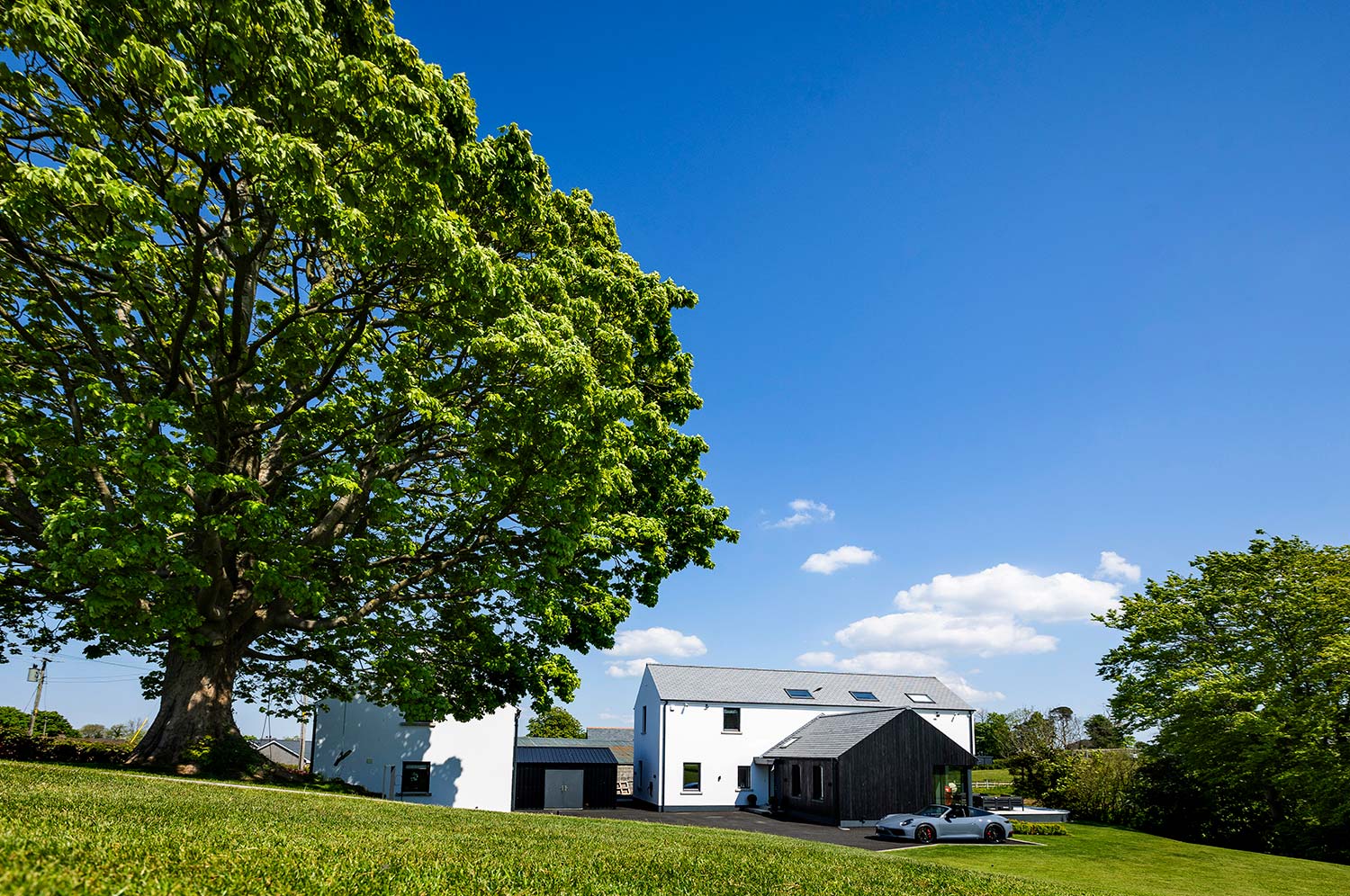
“Our travels inspired us to create a home that blends the sturdy character of Gulf homes, the practicality of well-designed spaces and the charm of a traditional farmhouse with modern design. With its burnt timber exterior and barn-style silhouette, the house tells the story of where we’ve been and who we are. Every decision was guided by the desire to create a home that feels both functional and soul-stirring.”
Finding land with planning permission already in place felt like striking gold to the couple. “The existing design was very close to what I had in mind, so I only needed to make a few minor adjustments. The changes were small but meaningful – tweaking window sizes, swapping out some exterior materials and opting for a barn style that would blend naturally into the landscape.”
“I worked with the original architectural designer to refine the design, adding burnt timber for contrast and balancing modern and traditional elements. Thankfully, the planning authority was on board, approving the tweaks without requiring a full resubmission.”
Designing with purpose
Richard decided to take a hands-on approach to the build. “With my aviation background, I approached the project like a complex flight plan, breaking it down into manageable stages.”
“We started with a solid set of plans, but managing the build during the pandemic wasn’t easy. But, with my piloting job reduced to minimal flying, I had the time to dive deep into the project. I worked 16-hour days, doing everything from groundwork to managing trades. It was exhausting but incredibly rewarding.”
“We prioritised quality over everything. I was adamant about taking a ‘fabric first’ approach, investing in insulation, windows and the core structure before worrying about cosmetic details. We made some tough choices, like sacrificing solar panels to keep the core build strong, but I believe we made the right decisions.”
Working with local tradesmen was important to the couple, says Richard. “We found a great builder who was upfront and easy to talk to, but I also did a lot of the work myself. This saved money but definitely took its toll.”
When designing their home, Richard knew the structure had to be rock-solid. “The whole approach was about investing in the bones of the house that you can’t change later. We went with a traditional dual-skin cavity wall, but with a twist: we made it 300mm thick instead of the standard 200 mm. I was adamant about insulation, so we used liquid insulation floor screed throughout, which gives us incredible thermal performance.”
“For the roof, we had to make a budget-conscious choice. Originally, I wanted a high-end slate roof, but we ended up with a composite material that looks just like slate. It’s actually vulcanised rubber, which is incredibly durable. Our neighbours have lost roof sections in storms while ours remains perfect.”
The glazing was a passion project for Richard. “We’ve got seven windows, not in a straight line, but at interesting angles, all facing south. They’re a mix of aluminium and UPVC. We couldn’t afford full aluminium, so we strategically placed the aluminium windows in key visual areas.”
“We’ve got floor-to-ceiling glass with a metre-deep overhang that catches the low winter sun perfectly and provides excellent thermal gain.”
After living in vastly different environments, from NI to the Middle East, Mark wanted a home that was equipped to provide a constant, comfortable living temperature. “We went with an air source heat pump, which was a bit of a compromise. Originally, I was keen on solar panels, but pandemic related budget constraints meant we had to make some tough choices.”
“The heat pump became our primary heating solution, integrated into a smart home system that allows us to control everything easily. Double glazing replaced my first choice of triple glazing, again due to budget limitations.”
“The air source heat pump, combined with a well-insulated structure, means we’re keeping energy costs down and maintaining a comfortable temperature.”
“We also installed an electric vehicle charger, which felt like a natural extension of our sustainability approach.”
Richard focused on creating spaces that were both functional and inviting. “The kitchen was my absolute passion. I wanted an open, minimalist space that would be the heart of our home. We went with anthracite grey units that ‘float’ against the background, with carefully placed LED lighting that creates different moods. The island became our centrepiece, with a downdraft extractor that keeps the lines clean and uncluttered.”
“The lighting was something I’m particularly proud of. As someone who used to work as an electrician, I knew I wanted to move beyond the basic single ceiling light. In the kitchen alone, we’ve got 13 different light circuits, but it boils down to creating just three lighting ‘scenes’ – cooking, dining and a chill mode. It’s all about creating atmosphere without complexity.”
The bathrooms were another area where Richard and Marie focused on both style and function. “We went for floor-to-ceiling porcelain tiles with some clever contrasts. In the main bathroom, I added an LED light behind the roll-top bath that creates these beautiful shadows at night. It’s those small details that make a space feel special.”
“Our utility room was all about practicality. We installed a central vacuum system – Marie’s idea, and honestly, it’s brilliant. The flooring is mostly tiles throughout, which makes cleaning a breeze and gives that clean, modern feel we were after.”
“The whole house is about creating spaces that work for us. Functional, but with personality. We didn’t want a show home; we wanted a home that tells our story.”
From the beginning, sustainability was more than just a buzzword for Richard and Marie; it guided every decision they made. “Sure, we had to make some compromises along the way, but we were committed to creating an environmentally conscious space.”
“One lesson I’ve learned: environmental choices aren’t about perfection; they’re about making the best decisions you can with the resources available. We may not have achieved everything we initially wanted, but we created a home that’s significantly more energy-efficient than a traditional build.”

Piloting the project
The site was completely overgrown when they bought it. “I spent hours clearing out the area, which was actually quite therapeutic for me, especially during a difficult time after losing my mum. We discovered this incredible natural feature, an island formed by a stream that runs into the lake, with two bridges.”
“Our approach to landscaping has been totally natural. We wanted to work with the existing landscape rather than impose something artificial. The plot is about an acre, and we’ve been intentional about preserving the natural beauty. We’ve got horses in the fields next to us, and our bedroom window overlooks this stunning view of the stream and surrounding landscape.”
“We’re taking it slow and doing small projects as we go along. Right now, we’re planning to add some triple doors to create better outdoor access, and we’ve got ideas for future developments like an outdoor kitchen area that overlooks the stream.”

Adapting on the fly
“When we started this journey, I thought I knew what I was getting into, but building a house is never as straightforward as you imagine. Covid threw us a massive curveball. My aviation career was cut to 50 per cent salary, which meant we had to make some tough financial compromises.”
“The biggest challenge was adapting on the fly. We went from having a clear vision to constantly adjusting our plans.”
“But the most unexpected twist came at the end of the build when I became ill. It is a stark reminder that no matter how passionate you are about a project, you can’t ignore your own health. Doing a lot of the work myself saved money but definitely took its toll. By the time we finished building in November, I was completely spent, so much so that I ended up in hospital on New Year’s Day with a collapsed lung and pneumonia. It made me realise how important it is to pace yourself and not push too hard.”
Now fully recovered, Richard is delighted with how the project turned out. “It hasn’t been easy, but standing here now, in a house we designed and largely built ourselves, it was worth every moment.
“This isn’t just a house – it’s our dream realised, a testament to perseverance and a space that truly feels like home.”

Suppliers
Architectural designer
McCullough Totten, mcculloughtotten.com
Stairs
Denny Rodgers, tel. 44830158,
[email protected]
Kitchen
Wrights Designs,
wrightsdesigns.co.uk
Tiling & bathrooms
DB Tiles & Bathrooms, tel.
92616950, [email protected]
Landscaping
JH Paving & Stonemasonry
Renewables
Daly Renewables, tel. 92667745,
dalyrenewables.com
Slates
Tapco
Screed
CES Cemfloor
Wall insulation
Kingspan Ecobead Platinum
ROI calling NI prefix with 048
Floor Plans

Spec
Walls: 400mm cavity wall construction, 100mm outer leaf blockwork finished in painted sand and cement render. Inner leaf 100mm block work with sand and cement scratch coat and skimmed internally. 200mm cavity was insulated with EPS beads, cold bridging reduced by installing 50mm fire-resistant high-density insulation at all reveals, heads and cills, U-value 0.15 W/sqmK.
Floor: 65mm liquid screed on 500 gauge polythene vapour barrier. 150mm concrete subfloor with anti-crack mesh, 150mm PIR insulation, U-value 0.12 W/sqmK.
Roofs: Pitched with manmade roofing slate on horizontal treated softwood slating battens. Breathable roofing membrane (taped and sealed for wind tightness), 100mm PIR insulation board between rafters with 50mm over, U-value 0.13 W/sqmK. Flat roof construction set to 1:60 fall. 1.5mm, anthracite colour, single ply uPVC membrane, loose laid and mechanically fixed, insulation 150mm PIR board, U-value 0.14 W/sqmK.


Q&A with Richard
What is your favourite design feature?
My favourite part of the house has to be the open plan kitchen and living space. It’s by far the best feature. It means we can all be doing different things without being completely separate. The kids can run around while the adults have their own space, and we still get to enjoy the views out onto the land.
It’s designed to be practical and easy to use, which is something I’ve always valued. It probably comes from my time as a pilot and a chef, where everything needs to have a purpose and flow well.
Biggest splurge?
The aluminium windows. They cost about £15,000 at the time, but I bought them before prices shot up during Covid. Now, they’d probably set you back around £30,000.
What would you change or do differently?
If I could do anything differently, I’d focus more on energy resilience. I really wanted to install solar panels, but the budget didn’t stretch that far at the time. A wood burning stove would’ve been great too, just as a backup for heating during power cuts. Looking at alternative energy sources for storms and outages is something I’d definitely reconsider. I’d also sort out a proper electrical backup. A generator that could handle the air source heat pump would give a bit more peace of mind in case of power interruptions. That said, I wouldn’t change a thing about the structure of the house itself. The location and design turned out even better than I expected, and I’m really happy with how everything came together.
What surprised you?
One of the biggest surprises was realising just how much I was capable of doing. Going into it, I wasn’t sure I had the skills to take on something this big, but I learned that if you break things down into manageable steps, even the most complex projects are doable. That being said, the whole process was way more complicated than I expected. There were so many interconnected decisions, and every choice seemed to have a knock-on effect to something else. It was a lot to keep on top of. The budget was another shock. Covid completely threw things off, and prices skyrocketed in ways I never could have predicted. I had to make some tough calls and sacrifices along the way, which wasn’t easy.